Live & payingAesthetic clinics & salons

FaceVision

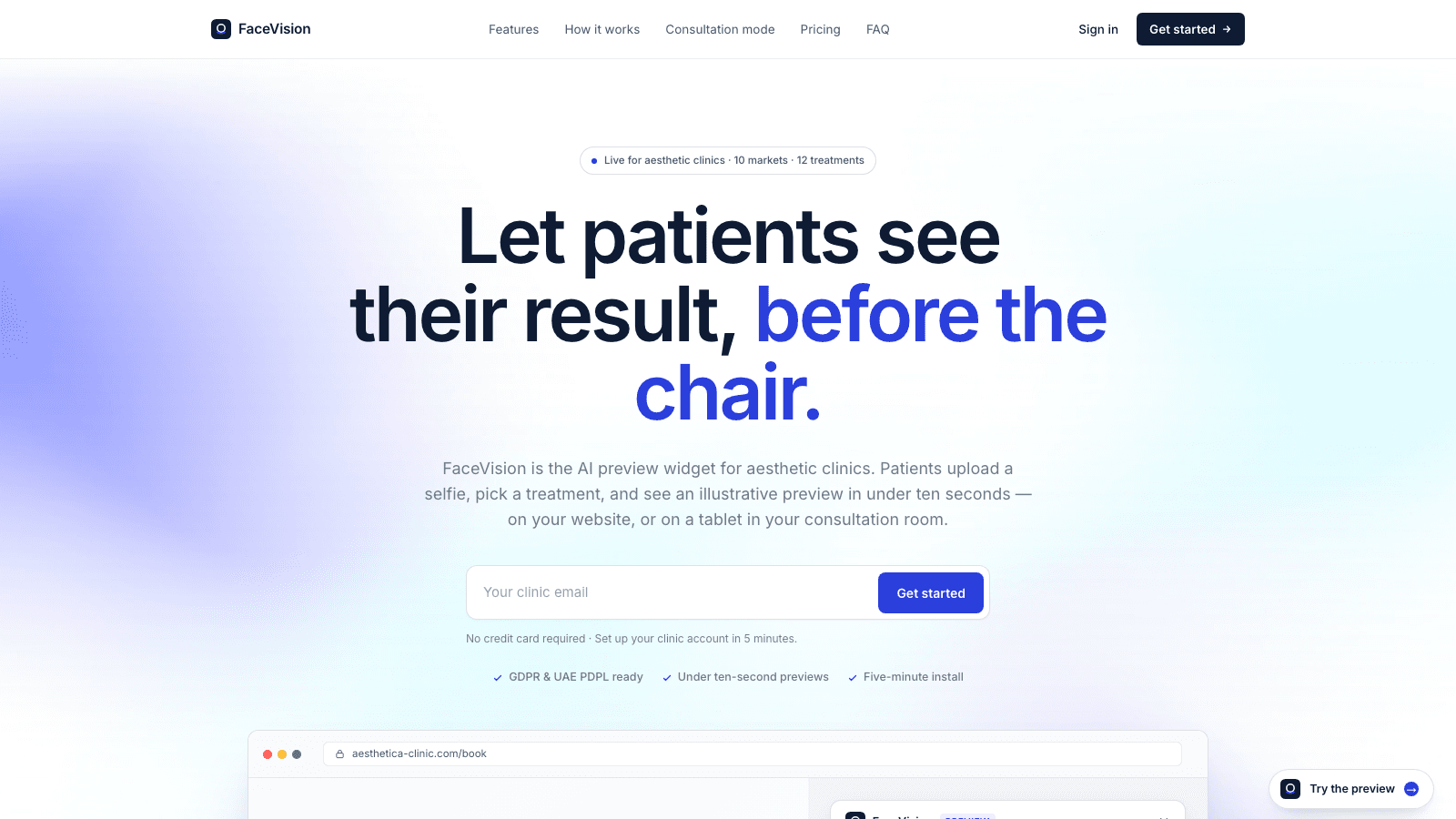
AI aesthetic preview for clinics and salons.

Prospective patients upload a selfie on the clinic's website and see a realistic preview of themselves after lip filler, cheek filler, jawline contouring, skin rejuvenation, or hair treatment, before they book a consultation. The clinic converts more of its high-CPL traffic into booked consultations; the patient walks in with expectations already shaped.

Included in €229/month all-access

Cancel anytime · 30-day money-back guarantee

  • All products included
  • 15% revenue share, no upsells
  • Cancel anytime
Overview

What FaceVision is, and who pays for it.

Plain-language description of the product, who buys it, the problem it solves, and the stack underneath.

FaceVision is a preview widget that embeds into an aesthetic clinic's or salon's website. A visitor selects the treatment they're considering, lip augmentation, cheek enhancement, jawline, skin peels, threads, hair treatments, uploads a selfie, and sees a realistic preview of the outcome within a few seconds.

The preview captures their email and routes the lead into the clinic's booking or CRM inbox. The result is a consultation booked by someone who has already self-selected a treatment and seen a plausible outcome, a materially higher-intent lead than one clicked in from a Google Ad.

Clients pay €149/month. All AI rendering and hosting costs sit inside that price.

Target customer
Medical-aesthetic clinics and medi-spas offering injectables, laser treatments, skin rejuvenation, and minor surgical procedures, this is the primary segment. Higher-end beauty salons offering aesthetic-adjacent treatments (microneedling, chemical peels, advanced facials, lash/brow treatments) are a valid secondary segment with different economics. The anti-profile: pure medical-surgical clinics (rhinoplasty, facelifts), where AI previews create unacceptable regulatory and clinical-expectation risk. Operators should not pitch those.
Problem it solves
Aesthetic treatments carry some of the most expensive per-click acquisition costs in healthcare. A click on a "lip filler" or "botox near me" Google or Meta ad typically runs €15-€50 in most European and Gulf markets, and a booked consultation costs €100-€400 in blended CPL. The leakage point is the same as dental: visitor arrives on the clinic's website, hesitates because they can't picture the outcome, closes the tab. Aesthetic treatments also carry outcome anxiety more strongly than dental, the visible, facial, permanent nature of the result makes "I need to see it first" the default posture. Previewing the outcome in a controlled, disclosure-wrapped widget converts hesitation into a booked consultation. A single additional lip-filler case (€300-€600) or two extra skin-rejuvenation packages (€1,500+) pays for FaceVision for a year.

Key features

  • Selfie-based, works on any smartphone; no professional photography or in-clinic imaging required.
  • Multi-treatment coverage, preset models for lip and cheek filler, jawline contouring, skin texture and tone rejuvenation, threads, and hair treatments. Each preset is capped at clinically plausible outputs.
  • Embeddable widget, drops into WordPress, Webflow, Squarespace, Wix, or a custom site via one script tag.
  • Lead capture and CRM routing, results emailed to the patient, lead routed to the clinic's booking inbox or existing CRM.
  • Clinic-branded, the patient sees the clinic's brand on every generated image and in every email; we are invisible.
  • Consent-first flow, explicit in-widget consent for photo processing, with configurable retention and an automatic "aesthetic preview only, not a clinical outcome" disclosure on every image.

Tech stack

  • Next.js 15 / React 19 widget delivered via script tag
  • Supabase (EU region by default; US region available) for storage, auth, lead capture, and analytics
  • Bias and fairness testing, weekly regression run against a reference set covering Fitzpatrick skin types I-VI and age bands from 20s to 60s
  • GDPR-compliant photo storage with 30-day default retention, configurable down to 24 hours
  • Automatic watermarking of generated images with the clinic's branding and regulatory disclosure
Market opportunity

Where FaceVision sits in the category.

Market size, growth, honest competitive landscape, and territory availability.

Global market

Global medical-aesthetics market reached roughly $17B in 2024 and is projected to grow ~10-12% annually through 2030 per Grand View Research and Allied Market Research benchmarks. Non-medical aesthetic services (salons, medi-spas without injectables) represent a larger but more fragmented TAM.

Addressable per country

A mid-sized European country has roughly 2,000-6,000 medical-aesthetic clinics and 10,000-30,000 aesthetic-adjacent salons. The addressable subset, clinics and salons that actively run paid acquisition for aesthetic treatments, is typically 20-30% of that. Even conservative penetration leaves several thousand qualified prospects per country.

Growth trend

Aesthetic treatments continue to grow roughly 10%+ annually in Europe and 15%+ in the Middle East. Injectables are the fastest-growing segment, "tweakment" culture, declining stigma, and younger first-time patients are structural tailwinds. Online booking and self-service acquisition are moving from optional to table stakes in the segment.

FaceVision’s edge

What structurally separates FaceVision from the competitors listed below.

  • Pre-booking clinic-acquisition tool, not a consumer filter. Every clinic-facing element is built to convert a visitor into a booked consultation, not to entertain a shopper.
  • Selfie-only, no professional photography, no in-clinic scan, no app. The friction cost of using FaceVision is measured in seconds, which is what matters in a clinic's ad-funnel tail.
  • Medical-grade consent and retention controls, built for GDPR Article 9 biometric data from day one, not retrofitted.
  • Multi-treatment in a single widget, lip, cheek, jawline, skin, threads, hair. A clinic that offers multiple treatments lists them all in one install.

Competitive landscape

Named in full, with notes on whether each is structurally a real competitor or commonly misidentified as one.

  • ModiFace (L'Oréal-owned)

    Visit ↗

    L'Oréal acquired ModiFace in 2018; powers AR try-on for L'Oréal brands and retail partners. Structurally aligned to L'Oréal product sales, not to driving bookings to independent clinics, the SmileVision/Align pattern repeats here. Frequently cited as a competitor; structurally isn't.

  • YouCam Makeup (Perfect Corp)

    Visit ↗

    Consumer AR try-on for makeup and skincare; owned by Perfect Corp. Not a clinic-acquisition tool; adjacent to the category without competing for the same buyer.

  • Well-funded aesthetic-preview startups

    A small number of venture-backed AI startups have launched aesthetic-preview tools for clinics. Typically US-first, priced €79-149/mo. Real clinic-segment competitors, willing to run on negative unit economics for market share. Exact names and flows change quickly in this category; the structural threat is the pattern, not any single entrant.

  • AestheticsPro / Aesthetic Record / Zenoti (practice management SaaS bundlers)

    Visit ↗

    Existing aesthetic-clinic practice management platforms, patient records, scheduling, inventory. They already have clinic relationships and could bundle a preview feature into their subscriptions on a 12-24 month horizon. Most plausible category-compression threat.

  • Instagram / TikTok filters and consumer AR

    Consumer-grade face filters exist in volume; they set the patient's visual vocabulary but do not solve the pre-booking conversion problem for a specific clinic. Adjacent, not competing.

  • In-house custom builds by large aesthetic chains

    Corporate aesthetic groups occasionally build bespoke tools. Independent clinics and salons, our operators' buyers, cannot match that spend, which is exactly the gap we address.

Territory availability

All countries are currently available on a non-exclusive basis. Strongest demand signals as of April 2026 come from the UAE, Saudi Arabia, UK, Germany, Italy, Spain, Portugal, Turkey (heavily saturated but very large), and Brazil. US and South Korea are large but sophisticated markets with incumbent players; operators entering those should budget accordingly.

Unit economics

The math, in tables.

Four scenarios, from Slow start to Exceptional. Each is a committed operator at a different execution level. Numbers are before tax and will vary by jurisdiction.

These scenarios assume the operator starts outbound in Week 1 and maintains cadence consistently. Operators who skip outbound weeks or launch slowly typically run in the Slow start band for their first 3-6 months before ramping.

Subscription payoff

Pays for itself at 2 paying clients.

Math
€229 / (€149 × 85%) = 1.80

Your subscription is €229/month. You keep 85% of what every client pays you, so each paying client nets you €127/month. Once you cross 2 paying clients, the subscription is paid for and everything above is operator take-home, minus the 15% marketplace share on that gross client revenue.

Slow start

1-2 new clients per month, 88% monthly retention. Typical for an operator who underestimates outbound volume, starts late, or runs into ICP-drift issues in month 1-2 (the aesthetic segment in particular rewards ICP discipline). Not a failure scenario — many successful operators run at this pace for their first 90 days before ramping.

MonthClientsGross MRRMarketplace 15%Operator take-home
M67€834€125€709
M1213€1,549€232€1,317
M1817€2,026€304€1,722
M2420€2,384€358€2,026
Cumulative year 1 take-home (at 85%)
€8,500
Cumulative year 2 take-home (at 85%)
€25,500

Steady

3-5 new clients per month, 93% monthly retention. Retention is slightly lower than SmileVision because the salon segment churns faster than medical clinics; operators focused exclusively on medical-aesthetic clinics should expect 95%+. 10-20 hours/week of outreach.

MonthClientsGross MRRMarketplace 15%Operator take-home
M620€2,980€447€2,533
M1233€4,917€738€4,179
M1842€6,258€939€5,319
M2448€7,152€1,073€6,079
Cumulative year 1 take-home (at 85%)
€29,750
Cumulative year 2 take-home (at 85%)
€63,750

Strong

6-9 new clients per month, 90% retention. Typical for an operator with prior aesthetics-adjacent experience (former injector, ex-medical-device sales, aesthetic-industry marketing) or an existing social-media presence the operator can pair with outbound. 25-35 hours/week.

MonthClientsGross MRRMarketplace 15%Operator take-home
M637€5,513€827€4,686
M1257€8,493€1,274€7,219
M1869€10,281€1,542€8,739
M2476€11,324€1,699€9,625
Cumulative year 1 take-home (at 85%)
€52,063
Cumulative year 2 take-home (at 85%)
€102,000

Exceptional

12-18 new clients per month, 88% retention. Typical for an experienced aesthetic-industry operator with an Instagram audience, clinic network, or running a small sales team. The aesthetic buyer responds strongly to social proof, a operator with their own aesthetic-industry presence compounds outbound faster than in other verticals. 40+ hours/week or one sales hire.

MonthClientsGross MRRMarketplace 15%Operator take-home
M663€9,387€1,408€7,979
M1292€13,708€2,056€11,652
M18109€16,241€2,436€13,805
M24117€17,433€2,615€14,818
Cumulative year 1 take-home (at 85%)
€90,313
Cumulative year 2 take-home (at 85%)
€164,688

Break-even, in plain English

At the subscription price of €229/month

2 clients

In the Steady scenario (3-5 new clinics per month) cumulative take-home crosses break-even around month 6-7. In the Strong and Exceptional scenarios it lands months 3-4. Slow Start operators typically cross between month 10 and 12. Figures are before your operational costs — see Operator costs below.

Unit economics

Gross margin / client
100%
Estimated LTV
€1,500
Typical CAC
€60 to €250

Aesthetic CAC is between e-commerce and dental. Clinic owners and salon principals are often founder-operators who respond to social and direct outreach faster than dentists. Instagram DM outreach is materially more effective in this vertical than in dental or e-commerce. The pre-loaded prospect list is filtered to clinics and salons already running paid acquisition, which is the correct subset.

Operator costs

  • Cold outreach tool (Instantly, Smartlead, Apollo, or similar)€50-100 / mo
  • Instagram engagement tool (Manychat, Instadam alternatives), unusually effective in this vertical€20-60 / mo
  • LinkedIn Sales Navigator (secondary channel here)€80 / mo (optional)
  • CRM, HubSpot free tier or similar is enough at this scale€0-50 / mo
  • Domain + business email€10-20 / mo
  • Aesthetic trade-event attendance (IMCAS, AMWC, regional expos)€800-3500 / event
  • Time investment10-20 hrs/wk Steady · 25-35 hrs/wk Strong · 40+ hrs/wk Exceptional

Figures pre-tax and vary by jurisdiction. Retention, close rate, and ramp assumptions are documented in each scenario row and should be checked against your own channel mix.

Sales system

How FaceVision operators get clients.

Channels, realistic conversion rates, and exactly who does what between the marketplace and the operator.

Avg. sales cycle
18 days
Realistic close rate
Roughly 4-8% of cold aesthetic prospects book a demo (higher than dental because clinic owners are more marketing-forward); 25-40% of demos sign within 30 days. Sales cycle is shorter than dental (often 2-3 weeks) because aesthetic clinic owners are typically also the decision-makers and respond to ROI arguments fast.
Time to first client
3-6 weeks for operators executing the Steady cadence. Operators with existing aesthetic-industry contacts or an Instagram audience typically close their first client within 2 weeks.

Primary acquisition channels

  • Instagram DM outreach to aesthetic clinic owners and salon principals, this is the strongest single channel in this vertical and noticeably more effective than in dental or e-commerce.
  • Cold email to clinic owners and practice managers (pre-loaded list filtered to aesthetic-active clinics).
  • Aesthetic industry events, IMCAS Paris, AMWC Monaco, Dubai Derma, regional aesthetic expos. High ROI once the operator has 3-5 reference clients.
  • Partnerships with aesthetic-product distributors and injectable training academies, they have the clinic relationships and will co-promote.
  • Referral through signed clinics, aesthetic is a referral-heavy segment; one strong reference clinic typically produces 2-5 warm intros in its region.
  • Paid collaboration with aesthetic-industry microinfluencers (clinic reviewers, aesthetic-nurse content creators), optional but high-yield in the Exceptional scenario.

What we provide

  • Pre-loaded prospect list of aesthetic clinics and qualifying salons in the operator's country (typically 500-2,500 filtered leads depending on market size).
  • Cold email and Instagram DM templates tuned for aesthetic decision makers. Tested across existing FaceVision clients. Languages: English, Dutch, German, French, Spanish, Italian, Portuguese, Arabic. Additional on request.
  • Demo script leading with CPL-efficiency math ("one extra lip-filler case pays for FaceVision for 4 months") and objection handling for the three most common pushbacks: consent and regulation, photo realism, website integration.
  • Live demo environment with an aesthetic-clinic-style sample site; operators can show the widget end-to-end in 60 seconds.
  • Branded dashboard at the operator's subdomain, every clinic and salon sees the operator's brand, never ours.
  • Sales training modules: aesthetic-industry ICP (who to target, who to decline), running a demo for a founder-operator, contract and consent flow, onboarding for both medical and non-medical buyers.
  • Medical vs non-medical contract templates, separate DPAs and consent disclosures for medical-aesthetic clinics versus beauty salons, with country-specific regulatory notes attached.
  • Direct founder access by email and in the Circle.so community during active deals.

What the operator provides

  • Time and the discipline to follow the ICP filter. The most common aesthetic-operator mistake is onboarding anyone who will pay €149/mo, including salons with no paid-acquisition activity, they churn within 90 days and wreck the retention assumption.
  • Sales execution and follow-up. Aesthetic decisions are fast but not instant; most deals close on the third or fourth touch.
  • Either an existing aesthetic-industry presence (clinic network, Instagram audience, past injector / aesthetics-sales career) or the willingness to build one in parallel with outbound. Operators without either reach 70-80% of the scenarios quoted here.
  • Local language for patient-facing disclosures, we provide templates, the operator adapts them.
30-day hands-on support

Your first 30 days on FaceVision, with an expert in the room.

You’re not buying software and a playbook. You’re getting a business expert working alongside you for your most critical month.

Your FaceVision expert knows the aesthetic clinic and salon sales cycle, including how the buyer varies (clinic owner vs. marketing lead vs. practice manager) and how to sell into both medical aesthetic and non-medical beauty segments.

Your FaceVision expert

Someone who has personally run this business, not a generalist, not a support agent. Assigned to you on day one, yours for 30 days.

Four weekly 1:1 meetings

Week 1 launch readiness. Week 2 pipeline review. Week 3 conversion. Week 4 scale plan. Your agenda, your calendar.

Daily async access

Slack or WhatsApp, under 4 hours on business days. Sales calls, copy, ad creative, positioning, not a ticket queue.

Community continues on day 31

Operator community, monthly group coaching, peer review on live deals. No cliff when your 30 days end.

The 30 days, step by step

Day 0 → Day 30
  1. Day 0
    Expert reaches out within 24 hours

    Your assigned expert emails within 24 hours of your license activating to schedule your Week 1 meeting and set up Slack or WhatsApp.

  2. Week 1
    Launch readiness

    ICP filter enforced (medical-aesthetic clinics first, salons only where they run paid acquisition), first 50 clinic and salon prospects locked, Instagram DM and cold email sequences armed with aesthetic-specific templates.

  3. Week 2
    Pipeline review

    Which channels produced replies (Instagram DMs usually outperform email here), which objections surfaced (biometric consent, bias across skin tones, website integration), adjusting the next cadence.

  4. Week 3
    Conversion optimization

    CPL-to-consultation demo diagnostics, closing conversations with founder-operator clinics, scripted response to 'what about bias across skin tones' and 'can we cap the realism'.

  5. Week 4
    Scale plan

    Whether to attend IMCAS or a regional expo, whether to run a microinfluencer collaboration, a written 90-day plan including the referral flywheel.

Risk assessment

What can go wrong with FaceVision.

Every meaningful risk, named. Each one includes a mitigation and, where we can't eliminate the risk, an explicit disclosure that we don't.

Low
Consider but unlikely to materially affect your business.
Medium
Active risk, addressable through execution.
High
Dominant factor in success or failure.

Regulatory

High severity

Risk

Aesthetic preview imagery sits at the intersection of several regulatory regimes. GDPR treats face photos as biometric data, special-category data under Article 9, requiring explicit consent and documented processing basis. Medical device regulation (MDR in the EU, FDA in the US) applies if the tool is interpreted as predicting a clinical outcome. Cosmetic-procedure advertising is restricted by jurisdiction-specific rules, UK ASA guidelines, Germany's Heilmittelwerbegesetz, France's public-health advertising code, UAE's DHA and DHCC codes (notably strict on aesthetic advertising). And the medical vs non-medical distinction matters: a preview shown by a beauty salon for a treatment that legally requires a medical license in that jurisdiction is a regulatory problem for both the salon and, by extension, the operator.

Mitigation

The product is scoped as aesthetic visualization, not clinical prediction. Every generated image carries a visible "aesthetic preview only; not a clinical outcome prediction" disclosure. Consent is collected in-widget before any upload. Medical and non-medical contract templates are separated, with the salon-facing contract restricting the preview to treatments legal for non-medical providers in the target jurisdiction. Country-specific advertising-compliance notes are provided to the operator. Honest disclosure: this mitigation depends on the operator enforcing the medical/non-medical filter when onboarding. The marketplace cannot audit every clinic's licensing in every country, we rely on the operator's judgement, which is why the sales training is explicit about who to decline.

Product

High severity

Risk

Face preview imagery is higher-stakes than tooth or room preview. A visibly unrealistic lip-filler preview sets patient expectations higher than the actual treatment can deliver, which is both a clinical disappointment risk and a consumer-protection exposure for the clinic. Bias across skin tones, ages, and facial structures is a more visible failure mode on face previews than on teeth or furniture, a model that works well for Fitzpatrick type II and poorly for type V is an equity and regulatory problem regardless of intent.

Mitigation

A bias and fairness regression suite runs weekly against a reference set spanning Fitzpatrick I-VI, age bands 20s-60s, and facial-structure variation. Treatment presets are capped at clinically plausible outputs, the lip-filler preset does not produce results unattainable with safe injectable volumes; the skin preset does not erase textural features the underlying treatment would not. Low-confidence previews are rejected in-widget with a message directing the patient to book a consultation rather than showing an unreliable image. Showing no preview is treated as strictly better than showing a misleading one.

Market

Low severity

Risk

Aesthetic-treatment demand is mildly recession-sensitive for discretionary spend (new injectable patients, packages), more stable for maintenance (existing injectable patients topping up, skincare regimens). A severe consumer downturn reduces new-patient acquisition, which reduces clinic marketing spend.

Mitigation

Like SmileVision, FaceVision is positioned as marketing-efficiency rather than additional spend. In downturns, clinics cut discretionary expansion but retain tools that improve conversion on existing traffic. Aesthetic clinic owners are typically the most marketing-literate operators in healthcare, they read ROAS, and a tool that moves CPL-to-consultation rates by 10-20% defends itself.

Competitive

Medium severity

Risk

ModiFace and YouCam Makeup are frequently cited as competitors, they're not. ModiFace is L'Oréal-owned and optimised to drive L'Oréal product sales through retail AR; its incentives route traffic to cosmetic-product discovery, not to booking consultations at independent clinics. YouCam is a consumer app, not a clinic-acquisition tool. The real pressure is quieter: (1) aesthetic-clinic practice management SaaS (AestheticsPro, Aesthetic Record, Zenoti) that already have clinic relationships and could add a preview feature as a line item in an existing subscription; and (2) venture-backed aesthetic-preview startups willing to run on negative unit economics for 18-24 months to capture clinic inventory. Either could compress category pricing.

Mitigation

Speed and switching cost, same as the other platforms. A operator with 30 aesthetic clinics on annual contracts, widget integrated, consent flow documented, staff trained, is durable against a cheaper competing feature because migration is measurable work for the clinic and carries regulatory-documentation overhead. The marketplace supplies annual contract templates and a 45-day onboarding that deepens the install. This does not eliminate the risk; it lengthens the window in which operators can lock in clients.

Execution

High severity

Risk

Aesthetic has one execution failure mode that is specific and unforgiving: ICP drift. Because aesthetic salons and clinics both exist, operators frequently take any €149/mo buyer, including salons not running paid acquisition. Those accounts churn within 60-120 days because the salon never saw a booking lift; that churn then shows up as lower retention in the operator's reporting even though the underlying tool works. Beyond ICP, typical aesthetic-sales mistakes are: leading with features instead of CPL-to-consultation math (the buyer does not care about the model; they care about ROAS), ignoring Instagram outbound (which outperforms email in this vertical), and underestimating the frequency of the follow-up cadence needed with a clinic owner who also treats patients 30 hours a week.

Mitigation

Sales training is aesthetic-specific: an ICP filter that explicitly disqualifies salons without paid-acquisition activity, a demo format that opens with ROAS math, a multi-channel outreach sequence including Instagram DMs, and a 4-5 touch follow-up cadence. Weekly founder office hours during the first 60 days are tuned to catch ICP drift, the most common early signal is a operator reporting "lots of signups" at month 2, which later shows up as a retention collapse at month 5. The 30-day refund window remains a genuine exit for operators who recognise the cadence does not fit them.

Platform

Medium severity

Risk

Operators depend on the marketplace continuing to operate FaceVision. If the marketplace shuts down, clinic installations stop working, damaging the operator's standing with signed clinics and salons.

Mitigation

The license contract includes a source-code escrow clause: if the marketplace ceases operations, active operators receive rights sufficient to continue serving existing clients. Infrastructure runs on Vercel and Supabase. This is a real risk, not zero, and we disclose it rather than minimising it.

Access

Your subscription, in plain English.

Subscribing to the marketplace lets you run FaceVision (and every other product) under your brand. No stage fees, no exclusivity locks unless you pay for them.

Included in your subscription
€229/ month all-access

This product + every other product in the marketplace. Same price regardless of how many you run.

  • Run FaceVision under your brand, domain, and billing
  • Full course for this product (2-5 hours of video)
  • Playbook: cold email, landing pages, sales scripts
  • Pre-loaded prospect list for your country
  • First-30-days hands-on support from an assigned expert
  • Operator community + weekly group office hours
  • Product updates delivered automatically
Subscription
€229/month all-access. Running FaceVision doesn't cost extra — add or remove it from your dashboard anytime.
Revenue share
You keep 85% of what your clients pay you. The 15% marketplace share is the only other cost, calculated monthly.
Cancel policy
Cancel anytime from your dashboard. Access continues through your current paid month. No partial-month refunds. Revenue-share obligations on what your clients have paid continue after cancellation.
Price lock
The €229 price is the price at signup. If the marketplace raises the subscription later, your existing subscription keeps its price while it stays active.
Non-compete (3 years)
Licensee may not build or operate a directly competing product in the licensed vertical for 3 years after the license agreement ends.
Refund policy
30-day money-back guarantee on your first month. No conditions, no retention call. Full refund minus payment processor fees.
Optional: country exclusivity

Lock FaceVision in a specific country

Subscription operators run non-exclusively by default — multiple operators can serve the same country. For a one-time fee you can convert your access to an exclusive lock for this product in a specific country. Pricing depends on market size; apply to get a quote.

Proof & track record

What FaceVision has done so far.

Current clients, founder credibility, and infrastructure posture. No fabricated testimonials.

Platform status
Platform live

End-client rollout begins with the first operator cohort.

Founder

Belgian entrepreneur based in Dubai. Several years building AI-native SaaS products; the marketplace is the first I've opened to the operator licensing model.

Infrastructure

Hosted on Vercel (edge) and Supabase (EU region by default; US or UAE region available for regulatory-locality reasons). Face photos stored with AES-256 at rest and TLS 1.3 in transit; default retention 30 days, configurable to 24 hours. Uptime target 99.9%.

No platform-specific testimonials are published yet. The marketplace does not publish testimonials without explicit client consent. Clients who consent to platform-specific quotes will be added here as they’re confirmed.

A note from the founder

SanderBelgian entrepreneur based in Dubai. Several years building AI-native SaaS products; the marketplace is the first I've opened to the operator licensing model.

FaceVision is the newest of the three live platforms, built on the same image-generation stack as SmileVision with the bias and fairness regression suite baked in from day one because face-preview equity is visible in a way tooth-preview equity isn't. I deliberately keep this platform smaller than RoomVision, refusing pure surgical cosmetic buyers and salons without paid-acquisition activity, because retention integrity matters more than volume while the playbook matures.

Current client count and cohort retention are available under NDA rather than published as round numbers. If we're a fit, you'll deal with me directly and I onboard every new operator in their first 30 days.

FAQ

FaceVision-specific questions.

The questions we get asked most often when a serious buyer is evaluating this platform.

Is this a medical device? Do we need MDR, CE, or FDA clearance?
No. FaceVision is deliberately scoped as aesthetic visualization rather than clinical outcome prediction. Every generated image carries a visible disclosure stating exactly that. This scope keeps the product outside medical device regulation (MDR in the EU, FDA 510(k) in the US) in every jurisdiction we have operated in to date. Medical-device classification is jurisdiction-specific and evolving; operators should confirm with local counsel before launch, we support that conversation and share the classification memo we use.
Can beauty salons without a medical license use FaceVision?
Yes, for treatments legal for non-medical providers in their jurisdiction, typically skin rejuvenation presets, microneedling, brow and lash, hair treatments. We provide a separate non-medical contract template that restricts the preview to those treatments. Salons cannot use FaceVision to preview injectables or laser treatments that legally require a medical license in their country. The operator enforces this at onboarding.
How does the model handle different skin tones, ages, and facial structures? Is bias a real concern?
Bias is a real concern and we address it explicitly. The model is fine-tuned on a dataset spanning Fitzpatrick skin types I-VI, ages 20s through 60s, and a range of facial structures. A weekly regression test runs against a reference set covering this variation; a quality drop on any subgroup triggers rollback or provider switch. Low-confidence previews (where the model cannot generate reliably) are rejected in-widget rather than shown. Honest disclosure: the reference set is expanded quarterly; operators operating in markets with distinct facial-structure distributions (East Asia, South Asia) should flag this during onboarding so we prioritise the relevant expansion.
How do we handle patient consent and GDPR for face photos?
Face photos are biometric data under GDPR Article 9. The widget collects explicit in-flow consent specifically covering biometric processing before any upload. Photos are stored with a default 30-day retention (configurable to 24 hours per clinic), never used for model training, and never leave our infrastructure. Each clinic signs a GDPR DPA with the operator, we provide the template. In the UAE and Saudi Arabia, a separate data-residency addendum is available.
Which treatments does the preview cover?
Lip augmentation, cheek filler, jawline contouring, thread lifts, skin rejuvenation (texture, tone), and hair treatments ship out of the box. Explicitly not supported: surgical procedures with permanent facial restructuring (rhinoplasty, facelifts, blepharoplasty). The marketplace declines to ship these because the outcome-expectation risk is unacceptable.
Does this integrate with aesthetic practice management software (Zenoti, Mindbody, Aesthetic Record)?
No direct integrations. FaceVision is separate software that runs on the clinic's public website and captures leads there. Those leads route into the clinic's booking inbox, or into any CRM that accepts an email or a webhook. The clinic keeps running Zenoti / Mindbody / Aesthetic Record independently for their internal operations — the two systems don't need to talk to each other.
What conversion lift should I promise clinics during the sales call?
Don't promise specific numbers on the first call. We provide anonymized performance data from existing clinics in your sales training materials. Share that data during the demo, not the cold email. Promising specific lift figures creates refund risk later if the clinic doesn't hit them.
My clinic already runs Meta and Google Ads, how does FaceVision fit the funnel?
FaceVision sits at the point where paid traffic lands on the clinic's website. A typical flow: Meta or Google Ad → landing page → FaceVision widget → email-captured lead → booked consultation. Clinics running €3,000-€15,000/month in paid spend typically see the largest lift, because the preview is extracting more bookings from traffic they're already paying for. We provide landing-page templates optimised for this flow.
How many clinics until I'm net-positive?
Two paying FaceVision clinics cover the €229/month subscription with margin. From clinic 3 onward, the subscription is net-positive each month. Cumulative break-even per scenario: Steady around month 6-7, Strong and Exceptional earlier, Slow Start around month 10-12. See Unit economics.
Subscribe · Run FaceVision

Start running FaceVision.

Included in your €229/month subscription. Keep 85% of what your clients pay you. Cancel anytime.

30-day money-back guarantee · No questions asked

Start my subscription