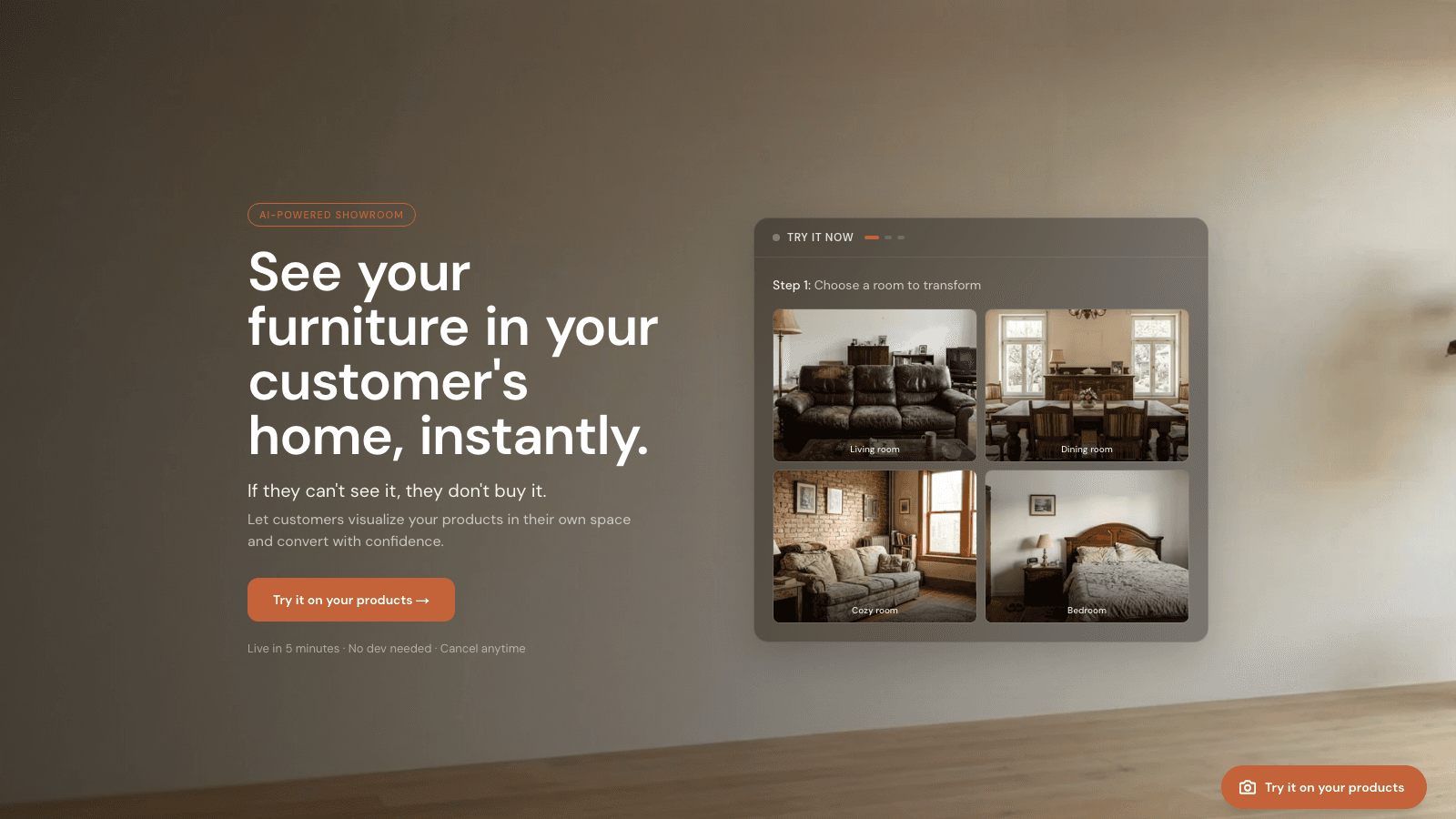
Shoppers upload a photo of their living room, bedroom, or office and see the webshop's products placed in that exact room, lit correctly, scaled correctly, in seconds. Higher conversion, fewer returns, a clear reason to pick this webshop over the one next to it.
Plain-language description of the product, who buys it, the problem it solves, and the stack underneath.
RoomVision lets a furniture webshop's visitors upload a photo of their own room and instantly see any product from the webshop's catalogue rendered in that room. The result looks photographic, not like an AR overlay, correct shadows, correct scale, correct perspective.
The webshop installs a short script, points RoomVision at their product catalogue, and the feature appears on every product page. No 3D models, no app download, no account required from the shopper.
Clients pay €199/month. Usage fees, hosting, and model costs sit inside that, they never see an AI bill.
Target customer
Independent and mid-sized furniture and home-decor webshops doing €500K-€10M in annual online revenue. They already invest in photography and product pages. They care about conversion rate and return rate. They are not large enough to build their own visualization tech but large enough to feel the pain of shoppers bouncing because they "can't picture it at home."
Problem it solves
Industry research (Baymard Institute, among others) consistently points to fit, scale, and style uncertainty as a leading driver of cart abandonment in furniture e-commerce. Returns for "did not match my home" are the single costliest reason in the category. RoomVision compresses the decision from "I'll think about it" to "that actually looks right" on the product page itself.
Key features
One-click room upload, shopper uploads a phone photo, no sign-up, no app.
Full catalogue support, the webshop's entire product feed is available, not a curated subset.
Photographic output, the rendering is shaded against the shopper's own lighting, not a flat composite.
Shareable previews, generated images carry the webshop's logo; shoppers send them to partners before buying.
Analytics dashboard, which products are being visualized, how often, with what conversion lift.
White-labelled, the feature carries the webshop's brand, not ours.
Tech stack
Next.js 15 / React 19 frontend embedded via script tag
Supabase for auth, storage of shopper-uploaded room photos, and client-side analytics
Hosted on Vercel with edge caching for catalogue lookups
GDPR-compliant image storage with configurable retention (default 30 days)
Market opportunity
Where RoomVision sits in the category.
Market size, growth, honest competitive landscape, and territory availability.
Global market
Global online furniture market reached roughly $250B in 2024 and is projected to grow in the high single digits annually through 2028, per Statista and Grand View Research benchmarks.
Addressable per country
A country like the Netherlands has roughly 3,000-5,000 furniture & home webshops in the €500K-€10M revenue band. Even 1% penetration in a single country is 30-50 paying clients, enough for a single operator to clear break-even several times over.
Growth trend
Furniture e-commerce penetration is still under 25% in most European markets, compared to 40%+ for fashion. AR and visualization tools have moved from "nice-to-have" in 2020 to "expected on the product page" in 2026 among top-100 retailers, but the long tail of independent webshops still runs plain product photography. That gap is the opening.
RoomVision’s edge
What structurally separates RoomVision from the competitors listed below.
Photo-realistic, not AR-overlay, renders against the shopper's real lighting rather than pasting a flat product image.
Works with existing 2D product photography, no 3D modelling required per SKU, which is the blocker that keeps 95% of the long tail off Threekit and most native AR viewers.
€199/month fixed fee with usage included, competitors either charge per-render (unpredictable for the webshop) or require enterprise contracts.
White-labelled and sub-second responsive, it feels native to the webshop, not bolted on.
Competitive landscape
Named in full, with notes on whether each is structurally a real competitor or commonly misidentified as one.
3D/AR configurator for enterprise brands; requires 3D asset production per SKU and is priced at enterprise-tier levels (typically $3–10k/mo based on public listings).
Acquired by CreativeForce; focuses on 360° product viewers rather than in-room placement.
Modsy
Shut down 2022, full-service virtual interior design. Market learned that concierge service is not the right unit economics.
Shopify / BigCommerce native AR
Glb/USDZ viewers available on higher-tier plans; require webshops to produce 3D models per SKU, which most don't have, this is why native AR has shipped for years without mainstream adoption. Shopify's app-store economics also favour third-party apps over native features here. Additionally, most mid-sized European furniture webshops run on WooCommerce, Magento, or custom stacks, not Shopify. Frequently named as the big threat but structurally isn't.
CreativeForce / Cylindo expanding
CreativeForce (which acquired Cylindo) already sells content automation and 360° viewers to furniture brands. They have the brand relationships to add photo-based room placement as an adjacent module on a 12-24 month horizon. The most plausible acquisition target or adjacent-expansion threat in the category.
PIM/DAM platforms with generative modules (Akeneo, Salsify, Bluestone PIM)
Product-content platforms mid-sized furniture brands already pay for. Each is shipping generative AI modules. A native "visualize in buyer's room" feature inside the PIM on an 18-36 month horizon is a real category pressure.
Well-funded AI startups at €49-99/mo
Barrier to entry with current diffusion models is low. A venture-backed entrant willing to run on negative unit economics for 18-24 months to acquire webshop inventory is the quickest-moving pressure in the category.
Marketplace-owned feature; only works for products listed on Houzz.
Territory availability
Already licensed
Netherlands
All other countries are currently available on a non-exclusive basis. Countries frequently asked about (Germany, France, UK, Belgium, Spain, Italy, US, Canada) have no operator yet as of April 2026.
Use cases & results
Use cases & results
RoomVision solves the same problem that drove Wayfair, DFS, EQ3, and West Elm to invest heavily in product visualization: furniture buyers abandon carts when they can't picture the piece in their own room. The industry data below is from retailers who deployed visualization tools in furniture e-commerce. RoomVision delivers the same shopper outcome without requiring per-SKU 3D modeling, which is what keeps most mid-sized webshops from deploying this category of tool today.
Large living room furniture (sofas, sectionals, armchairs)
The problem
Sofas and sectionals carry the highest per-unit return rate in furniture e-commerce, and the reason shoppers give in post-purchase surveys is consistent: the piece looked different in their actual room than on the product page. Scale, proportion, and style fit against existing décor are difficult to assess from catalogue photography alone.
The RoomVision application
RoomVision renders the exact sofa at correct scale and lighting in the shopper's uploaded room photo. The shopper sees real proportions against their own walls, windows, and adjacent furniture before committing to a four-figure purchase.
Industry benchmarks
Houzz: Users engaging with "View in My Room 3D" are roughly 11x more likely to convert than users browsing without it.Houzz press release, 2018
Wayfair: Public earnings commentary and engineering posts have cited materially higher conversion on SKUs with 3D/AR visualization versus static photography.Wayfair investor communications and engineering blog
Baymard Institute: In furniture e-commerce UX studies, inability to assess size and fit in the shopper's own space is the most-cited driver of cart abandonment in the category.Baymard Institute furniture e-commerce research
What the operator pitches
Every sofa your webshop ships that gets returned costs you freight both ways, restocking, and often resale at a markdown. RoomVision lets the shopper see the actual piece in their actual room before they click buy. The ones who still click buy return at materially lower rates.
Dining and bedroom furniture (tables, beds, wardrobes)
The problem
Dining tables and beds have hard proportional constraints. Will the 240cm table leave clearance for chairs on all sides? Does the king-size bed allow movement around the nightstands? These are the questions that stop buyers from completing checkout on high-ticket items with strict measurement requirements.
The RoomVision application
RoomVision places the exact product at correct scale in the buyer's photographed room. Proportional fit becomes a visual check, not a measuring-tape exercise.
Industry benchmarks
Williams-Sonoma (West Elm parent): Earnings commentary has cited meaningful conversion improvements from 3D/AR visualization tools on high-consideration furniture categories.Williams-Sonoma quarterly earnings calls
Crate & Barrel: Shoppers engaging with "3D Room View" convert at elevated rates versus non-users; retail case studies have reported 2-3x ranges.Retail industry case-study coverage
Industry aggregate: Returns on large furniture (beds, dining tables, wardrobes) in online channels run 15-40% depending on category, per furniture-industry benchmarks.Statista and furniture-industry benchmark studies
What the operator pitches
Your webshop probably already runs size guides and dimension charts. Those are necessary, not sufficient. A shopper who sees the bed in their own room doesn't second-guess the measurements at checkout.
Rugs, lighting, and large decor
The problem
Rugs are returned at rates higher than almost any other furniture category because buyers systematically underestimate how a 160x230 behaves in their actual room versus a 200x300. Pendant lighting, oversized art, and large mirrors have the same scale-guessing problem, and every buyer has imagined one of these wrong in the space before ordering.
The RoomVision application
RoomVision shows the rug at correct proportions relative to visible existing furniture, the pendant light at correct height against the ceiling, the mirror at correct wall scale. The scale question is answered before the cart decision.
Industry benchmarks
Anthropologie Home / Urban Outfitters group: AR tooling for rug and large-decor visualization has been deployed across the group, with retailers reporting reductions in scale-sensitive-SKU returns.Retail trade press
IKEA Place: IKEA's AR placement app has been documented in Apple case studies and IKEA communications as driving higher purchase confidence on scale-sensitive items.IKEA + Apple case studies, 2018-2020
Industry aggregate: Rug returns in online channels are consistently higher than average furniture returns, with scale mismatch as the top-cited driver in buyer surveys.Furniture-industry return-rate surveys
What the operator pitches
Rugs and lighting are lower-ticket items where the hesitation is the same as on sofas: the shopper can't picture the scale. RoomVision collapses that hesitation into a five-second visual.
Modular and configurable products multiply choice paralysis. A sectional with six module options, five fabric choices, and three layouts creates 90 possible configurations. The shopper cannot evaluate them against their room without visualizing each, and configuration abandonment is a top-cited conversion killer on modular product pages.
The RoomVision application
RoomVision previews the specific configuration, modules, fabric, and layout, in the shopper's own room, with adjust-and-re-preview on the fly. Configuration commitment happens faster and with less doubt.
Industry benchmarks
Threekit customers: 3D/AR configurators deployed on modular furniture have been publicly documented as reducing configuration abandonment across multiple brands in the category.Threekit customer case studies
West Elm: Modular-product AR/3D investment has been discussed in omnichannel context, with conversion improvements referenced in retail trade coverage.Williams-Sonoma retail trade coverage
Industry aggregate: Configuration complexity is among the most-cited drivers of abandonment on modular furniture, per retail research from McKinsey and Statista.McKinsey retail reports and Statista
What the operator pitches
Configurable furniture is where AOV goes up and return rate goes up at the same time. RoomVision removes one side of that trade-off: shoppers who preview the exact config they are buying return at materially lower rates than shoppers who guessed.
Outdoor and garden furniture
The problem
Outdoor furniture is highly seasonal, highly visual, and highly returns-sensitive. Shoppers must imagine a patio sectional against their specific deck, terrace, or garden without the benefit of a showroom walkthrough, and the decision window is compressed by weather and summer-season urgency.
The RoomVision application
RoomVision works on outdoor photographs identically to indoor. The shopper uploads a patio or garden photo and sees the outdoor sofa or dining set at correct scale against their actual hardscape, foliage, and daylight.
Industry benchmarks
Wayfair: The outdoor segment has been a focus of 3D/AR visualization investment, per public investor communications.Wayfair quarterly communications
UK furniture retailers (DFS and peers): UK retailers including DFS have invested in room-visualization tooling, with trade press reporting 15-30% conversion improvements on visualized SKUs across the category.UK retail trade press
Industry aggregate: Outdoor furniture returns consistently run higher than indoor furniture returns, driven by visualization difficulty and seasonal-urgency purchase patterns.Furniture-industry return-rate research
What the operator pitches
Outdoor season lasts three to four months in most of Europe. A shopper who visualizes the patio set in their actual garden in May buys it in May. A shopper who cannot pushes the decision into June, and a meaningful share of those decisions never come back.
The category is moving, the question is whether your webshop moves with it
Every major furniture retailer listed above has invested in some form of product visualization. They did it because the gap between "I can picture this in my room" and "I can't" is the single largest margin variable in furniture e-commerce. The question mid-sized webshops face is not whether visualization works, that is settled. The question is whether they can afford per-SKU 3D-modeling, which is what keeps this capability concentrated at the top of the market today. RoomVision collapses that cost to a script install. The operator opportunity is the long tail of furniture webshops in the licensed country that would adopt this category of tool if it didn't require 3D assets they don't have.
Conversion lift
20-40%
Return reduction
10-25%
AOV uplift
5-15%
Revenue per visitor
15-30%
ROI payback
<6 months
Benchmarks cited above are drawn from public filings, press releases, and industry research (Baymard Institute, Statista, McKinsey retail reports, and retailer investor communications). Specific figures are representative of the category, not guarantees of individual webshop results. Actual outcomes depend on traffic quality, catalogue depth, existing conversion baseline, and execution. Treat these as directional benchmarks; validate against your own cohort before citing them back to a buyer.
Unit economics
The math, in tables.
Four scenarios, from Slow start to Exceptional. Each is a committed operator at a different execution level. Numbers are before tax and will vary by jurisdiction.
These scenarios assume the operator starts outbound in Week 1 and maintains cadence consistently. Operators who skip outbound weeks or launch slowly typically run in the Slow start band for their first 3-6 months before ramping.
Subscription payoff
Pays for itself at 2 paying clients.
Math
€229 / (€199 × 85%) = 1.36
Your subscription is €229/month. You keep 85% of what every client pays you, so each paying client nets you €169/month. Once you cross 2 paying clients, the subscription is paid for and everything above is operator take-home, minus the 15% marketplace share on that gross client revenue.
Slow start
1-2 new clients per month, 90% monthly retention. Typical for an operator who underestimates outbound volume, starts late, or runs into learning-curve execution issues in month 1-2. Not a failure scenario — many successful operators run at this pace for their first 90 days before ramping.
Month
Clients
Gross MRR
Marketplace 15%
Operator take-home
M6
8
€1,270
€191
€1,080
M12
15
€2,385
€358
€2,027
M18
20
€3,180
€477
€2,703
M24
24
€3,816
€572
€3,244
Cumulative year 1 take-home (at 85%)
€12,750
Cumulative year 2 take-home (at 85%)
€40,375
Steady
3-5 new clients per month, 95% monthly retention. Typical for a committed operator doing consistent outbound, around 20 targeted emails/day, disciplined follow-up, one demo per day. 10-20 hours/week.
Month
Clients
Gross MRR
Marketplace 15%
Operator take-home
M6
21
€4,179
€627
€3,552
M12
37
€7,363
€1,104
€6,259
M18
48
€9,552
€1,433
€8,119
M24
57
€11,343
€1,701
€9,642
Cumulative year 1 take-home (at 85%)
€44,625
Cumulative year 2 take-home (at 85%)
€98,813
Strong
6-9 new clients per month, 92% monthly retention. Typical for an operator with prior B2B sales experience or an existing contact base in furniture / home e-commerce, treating this as their primary focus. 25-35 hours/week.
Month
Clients
Gross MRR
Marketplace 15%
Operator take-home
M6
39
€7,761
€1,164
€6,597
M12
63
€12,537
€1,881
€10,656
M18
78
€15,522
€2,328
€13,194
M24
87
€17,313
€2,597
€14,716
Cumulative year 1 take-home (at 85%)
€79,688
Cumulative year 2 take-home (at 85%)
€157,250
Exceptional
12-18 new clients per month, 90% monthly retention. Typical for an experienced B2B sales operator running a small team, or a operator with a warm distribution channel (existing agency, newsletter, industry audience). 40+ hours/week or a small sales hire.
Month
Clients
Gross MRR
Marketplace 15%
Operator take-home
M6
70
€13,930
€2,090
€11,841
M12
108
€21,492
€3,224
€18,268
M18
128
€25,472
€3,821
€21,651
M24
138
€27,462
€4,119
€23,343
Cumulative year 1 take-home (at 85%)
€140,250
Cumulative year 2 take-home (at 85%)
€258,188
Break-even, in plain English
At the subscription price of €229/month
2 clients
In the Steady scenario (3-5 new clients per month) cumulative take-home crosses break-even around month 5. In the Strong and Exceptional scenarios it lands months 2-4. Slow Start operators (1-2 clients per month for the first quarter) typically cross between month 10 and 12. Figures are before your operational costs — see Operator costs below.
Unit economics
Gross margin / client
100%
Estimated LTV
€1,990
Typical CAC
€50 to €200
CAC depends entirely on channel mix. Cold email with a €80/mo tool and the operator's own time lands at the low end. Paid LinkedIn ads or event sponsorship push it higher. The marketplace's pre-loaded prospect list is designed to keep CAC in the €50-100 range in year 1.
Operator costs
Cold outreach tool (Instantly, Smartlead, Apollo, or similar)€50-100 / mo
LinkedIn Sales Navigator (optional)€80 / mo
CRM, HubSpot free tier or similar is enough at this scale€0-50 / mo
Travel to industry events (optional, not required)variable
Figures pre-tax and vary by jurisdiction. Retention, close rate, and ramp assumptions are documented in each scenario row and should be checked against your own channel mix.
Sales system
How RoomVision operators get clients.
Channels, realistic conversion rates, and exactly who does what between the marketplace and the operator.
Avg. sales cycle
21 days
Realistic close rate
Roughly 3-8% of qualified cold prospects book a demo; of those, 25-40% sign within 30 days. Cycle is shorter when the buyer is the founder (1 demo, 1 follow-up); longer when there's a marketing committee.
Time to first client
3-6 weeks for operators executing the Steady outreach cadence. Strong and Exceptional operators usually close within the first 3 weeks.
Primary acquisition channels
Cold email to furniture-webshop decision makers (the pre-loaded list targets exactly this).
LinkedIn outbound to e-commerce managers and founders.
Industry events, furniture & interior trade fairs; referral through suppliers.
Inbound from the operator's branded landing page (we provide the template).
Partner channel, web agencies that build Shopify/WooCommerce stores for furniture brands.
What we provide
Pre-loaded prospect list of verified furniture webshops in the operator's country (typically 100-500 leads depending on market size).
Cold email templates tested across the existing 5 paying clients, in English, Dutch, German, and French. Additional languages on request.
Demo script with objection-handling crib sheet.
Live demo environment, the operator can show RoomVision running on a real sample catalogue in under 30 seconds.
Branded dashboard at the operator's own subdomain, the client sees the operator's brand, never ours.
Sales training modules in the dashboard: outbound setup, first-meeting playbook, pricing conversations, closing.
Direct access to the founder via email and the Circle.so community for questions during active deals.
What the operator provides
Time. 10-20 hours/week for the Steady scenario; substantially more for Strong and Exceptional.
Sales execution, the marketplace can't do the outreach for the operator.
Follow-up discipline. Most deals in this category close on the third or fourth touch.
Local context, language, local case studies once the first clients sign, knowledge of regional quirks.
30-day hands-on support
Your first 30 days on RoomVision, with an expert in the room.
You’re not buying software and a playbook. You’re getting a business expert working alongside you for your most critical month.
Your RoomVision expert has personally run this product in the Netherlands pilot. They know the furniture-webshop ICP, the objections ("we tried 3D models", "our agency handles this"), and the pricing conversations specific to €199/mo SaaS sales into European furniture e-commerce.
Your RoomVision expert
Someone who has personally run this business, not a generalist, not a support agent. Assigned to you on day one, yours for 30 days.
Four weekly 1:1 meetings
Week 1 launch readiness. Week 2 pipeline review. Week 3 conversion. Week 4 scale plan. Your agenda, your calendar.
Daily async access
Slack or WhatsApp, under 4 hours on business days. Sales calls, copy, ad creative, positioning, not a ticket queue.
Community continues on day 31
Operator community, monthly group coaching, peer review on live deals. No cliff when your 30 days end.
The 30 days, step by step
Day 0 → Day 30
Day 0
Expert reaches out within 24 hours
Your assigned expert emails within 24 hours of your license activating to schedule your Week 1 meeting and set up Slack or WhatsApp.
1
Week 1
Launch readiness
Sample catalogue loaded, your branded demo live, first 40 prospects locked from the pre-loaded furniture-webshop list, outbound sequence armed in your cold-email tool.
2
Week 2
Pipeline review
Which outbound emails landed, which objections surfaced ("we tried 3D models before", "our agency handles this"), and adjusting the cadence for the next 14 days.
3
Week 3
Conversion optimization
Demo-to-close diagnostics on your live deals. Sales-call debriefs (you record, your expert reviews). Pricing-conversation scripting for webshops pushing back on €199/mo.
4
Week 4
Scale plan
What worked in your country, where to invest the next 60 days, whether to stack a second platform, a written 90-day operating plan.
Risk assessment
What can go wrong with RoomVision.
Every meaningful risk, named. Each one includes a mitigation and, where we can't eliminate the risk, an explicit disclosure that we don't.
Low
Consider but unlikely to materially affect your business.
Medium
Active risk, addressable through execution.
High
Dominant factor in success or failure.
Market
Medium severity
Risk
Furniture e-commerce growth is correlated with housing market activity and consumer confidence. A prolonged downturn in either reduces webshops' willingness to adopt new paid tools.
Mitigation
RoomVision is pitched as a conversion-rate improvement, not an expense. In downturns, webshops prioritise tools that lift conversion on existing traffic, which is exactly this product. Pricing at €199 keeps it below most webshops' discretionary-software threshold.
Competitive
Medium severity
Risk
Shopify and BigCommerce are often cited as the threat, they're not. Shopify's app-store economics favour third-party apps over native features; their existing native AR has been shipped for years and hasn't taken hold because of the per-SKU 3D-modelling blocker; and the primary RoomVision buyer (a €500K-€10M European furniture webshop) is more often on WooCommerce, Magento, or a custom stack than on Shopify in the first place. The real pressure is quieter: (1) furniture-content SaaS already inside brand relationships (CreativeForce/Cylindo, Threekit moving down-market) adding photo-based room placement as an adjacent module; (2) PIM/DAM platforms (Akeneo, Salsify, Bluestone) shipping generative visualization as a native feature inside software the webshop already pays for; and (3) well-funded AI startups willing to run on negative unit economics at €49-99/mo to capture the long tail. Any of these could compress pricing in the category on a 12-36 month horizon.
Mitigation
The counter is speed and embedded switching cost. A operator with 40 webshops on annual contracts, each with the widget wired into product pages, analytics tuned, and staff trained on the dashboard, is durable even against a cheaper competing feature, because migration is measurable work for the webshop. The marketplace supports this with annual-contract templates and a 60-day integration process that deepens the install beyond "drop a script tag". This risk does not go to zero and we do not claim otherwise, only that the window to build switching cost is real.
Execution
High severity
Risk
The Steady scenario already assumes a committed operator running daily outbound. The failure modes that actually hurt operators at this level are subtler: targeting the wrong segment (pitching €199/mo to webshops doing <€200K/yr, who churn within 90 days), weak demo execution (walking through features instead of simulating a shopper flow), poor follow-up cadence (most deals in this category close on the fourth or fifth touch, giving up at touch two is the most common mistake), and weak onboarding of signed clients, which quietly erodes the retention assumption month by month. An operator who signs 5 new/month but retains at 80% instead of 95% ends up meaningfully below the Steady table within a year.
Mitigation
The sales training is built around ICP discipline (the pre-loaded list is already filtered to webshops in the €500K-€10M band for this reason) and a four-touch outbound sequence with scripted follow-ups. Onboarding retention is addressed by a 30-day activation checklist the operator walks every client through; clients who complete it retain above 95% in the existing cohort. Weekly founder office hours during the first 60 days surface execution problems before they compound. The 30-day money-back window is positioned deliberately: a operator who realises within the first month that they cannot execute the cadence should take the refund, that's what it's there for, not as a safety net to roll the dice.
Product
Medium severity
Risk
AI image-generation costs could rise if underlying model providers change pricing, or model quality could regress with a version change.
Mitigation
We absorb the image-gen cost inside the €199 client price and run multiple model providers in parallel with automatic fallback. Cost increases hit the marketplace, not the operator's margin. Model quality is monitored via a weekly regression test against a reference set of rooms + products.
Regulatory
Low severity
Risk
Shoppers upload photos of their homes. GDPR classifies room photos as personal data; accidental retention or mishandling is a regulator-attention issue in the EU.
Mitigation
Default retention is 30 days, configurable down to 24 hours per client. No photos leave our infrastructure or are used for model training. The operator receives a GDPR-ready data-processing addendum to sign with each client.
Platform
Medium severity
Risk
Operators depend on the marketplace continuing to operate RoomVision. If the marketplace shuts down, clients' installations stop working.
Mitigation
The license contract includes a source-code escrow clause: if the marketplace ceases operations, active operators receive rights sufficient to continue serving existing clients. Infrastructure is hosted on Vercel + Supabase, not on founder-owned servers, which keeps the continuity bar low. This is not a zero-risk mitigation, a multi-operator platform can still fail. We disclose it.
Access
Your subscription, in plain English.
Subscribing to the marketplace lets you run RoomVision (and every other product) under your brand. No stage fees, no exclusivity locks unless you pay for them.
Included in your subscription
€229/ month all-access
This product + every other product in the marketplace. Same price regardless of how many you run.
Run RoomVision under your brand, domain, and billing
First-30-days hands-on support from an assigned expert
Operator community + weekly group office hours
Product updates delivered automatically
Subscription
€229/month all-access. Running RoomVision doesn't cost extra — add or remove it from your dashboard anytime.
Revenue share
You keep 85% of what your clients pay you. The 15% marketplace share is the only other cost, calculated monthly.
Cancel policy
Cancel anytime from your dashboard. Access continues through your current paid month. No partial-month refunds. Revenue-share obligations on what your clients have paid continue after cancellation.
Price lock
The €229 price is the price at signup. If the marketplace raises the subscription later, your existing subscription keeps its price while it stays active.
Non-compete (3 years)
Licensee may not build or operate a directly competing product in the licensed vertical for 3 years after the license agreement ends.
Refund policy
30-day money-back guarantee on your first month. No conditions, no retention call. Full refund minus payment processor fees.
Optional: country exclusivity
Lock RoomVision in a specific country
Subscription operators run non-exclusively by default — multiple operators can serve the same country. For a one-time fee you can convert your access to an exclusive lock for this product in a specific country. Pricing depends on market size; apply to get a quote.
Proof & track record
What RoomVision has done so far.
Current clients, founder credibility, and infrastructure posture. No fabricated testimonials.
Live end-clients
5
End-clients paying for RoomVision across active operator territories.
Founder
Belgian entrepreneur based in Dubai. Several years building AI-native SaaS products; the marketplace is the first I've opened to the operator licensing model.
Infrastructure
Hosted on Vercel (edge) and Supabase (EU region by default, US region on request). Infrastructure tier is production-grade; operator usage data starts accumulating with the first signed cohort.
No platform-specific testimonials are published yet. The marketplace does not publish testimonials without explicit client consent. Clients who consent to platform-specific quotes will be added here as they’re confirmed.
A note from the founder
Sander — Belgian entrepreneur based in Dubai. Several years building AI-native SaaS products; the marketplace is the first I've opened to the operator licensing model.
RoomVision is where the marketplace started. I ran the Netherlands pilot personally, signed the first paying clients, and iterated the playbook against their feedback. That's why it's the first platform I opened to outside operators.
If we're a fit, you'll deal with me directly. I onboard every new operator in their first 30 days.
FAQ
RoomVision-specific questions.
The questions we get asked most often when a serious buyer is evaluating this platform.
Does RoomVision work for webshops outside furniture, lighting, decor, rugs, art?+
Yes, with caveats. The model is tuned on furniture and large home objects. Lighting, rugs, and wall art render well. Small objects (vases, candles, books) work but the lift over plain product photography is smaller, so we don't recommend pitching those verticals as a primary sale.
What platforms does the install support, Shopify, WooCommerce, Magento, custom?+
All of them. We build the integration for every client from scratch, so Shopify, WooCommerce, Magento, BigCommerce, Shopware, and fully custom stacks are all supported. Tell us the client's platform during onboarding and we confirm the integration path before the first client signs.
What conversion lift should I promise clients during the sales call?+
Don't promise specific numbers on the first call. We provide anonymized performance data from existing clients in your sales training materials. Share that data during the demo, not the cold email. Promising specific lift figures creates refund risk later if the client doesn't hit them.
How many clients until I'm net-positive?+
Two paying RoomVision clients cover the €229/month subscription with margin. From client 3 onward, the subscription is clearly in the black each month. See Unit economics for the cumulative ramp per scenario — Steady reaches break-even around month 5, Slow Start around month 10-12.
Can I run RoomVision in more than one country?+
Yes. Your subscription is marketplace-wide, not per-product-per-country. Run RoomVision in multiple countries simultaneously from one dashboard. Country exclusivity is an optional one-time upgrade per product per country; without it, multiple operators can serve the same country (the default).
What languages does the shopper-facing interface support?+
All languages common in your country of choice. A Netherlands operator gets Dutch and English; a DACH operator gets German; a France operator gets French; and so on. The localization work is included in onboarding and runs in parallel with your first weeks of outreach.
If AI image generation quality drops after a model change, what happens to my clients?+
We monitor quality weekly against a reference test set. If a model change degrades output, we roll back or switch providers before the client notices. This has happened twice in the past 18 months; neither incident produced a client-reported issue.
Who owns the data, the shopper photos, the webshop analytics?+
The webshop (our client) owns the analytics on their own catalogue. The shopper owns the photo they uploaded; it is retained for the configured window (default 30 days) then deleted. The marketplace retains aggregated, non-identifying usage metrics for product improvement. The operator sees the same analytics their client does, in their dashboard.
Subscribe · Run RoomVision
Start running RoomVision.
Included in your €229/month subscription. Keep 85% of what your clients pay you. Cancel anytime.